
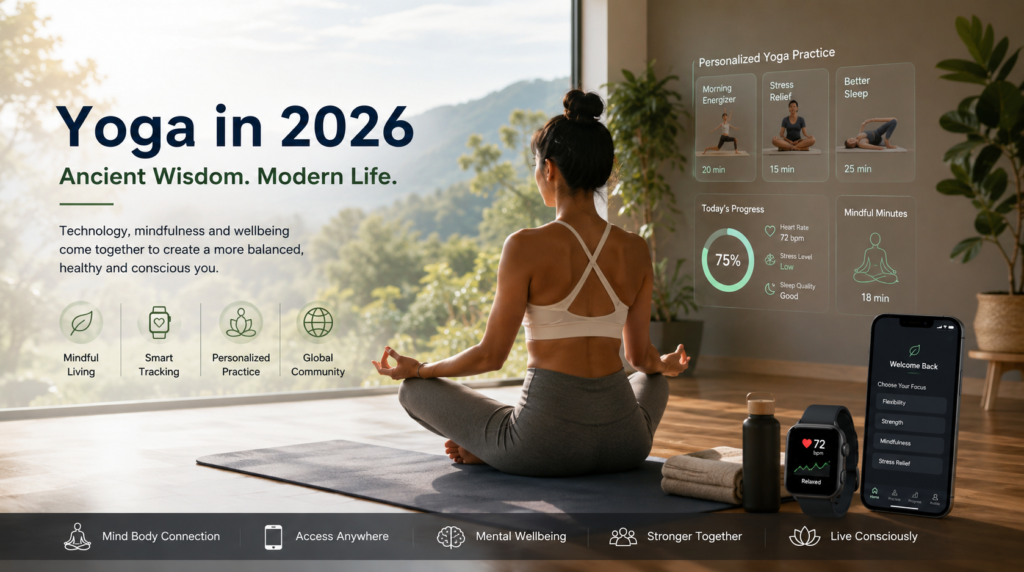
Yoga has been practiced for thousands of years, rooted in ancient Indian traditions that focus on the connection between the body, mind, and inner self. Traditionally, yoga was more than a form of physical exercise. It was a holistic way of living that included physical postures, breathing techniques, meditation, self-discipline, and spiritual awareness.
But as we step into 2026, yoga has evolved significantly.
Today, yoga is no longer limited to quiet ashrams, traditional yoga studios, or early-morning sessions on a mat. It has become a global wellness movement that fits into the fast-paced lifestyles of modern individuals. From AI-powered yoga apps and virtual instructors to workplace wellness programs, wearable technology, personalised routines, and hybrid yoga classes, the practice has embraced modern technology while continuing to preserve its timeless principles.
So, how exactly is yoga being modernised in 2026?
Let’s explore the major changes shaping the future of yoga.
1. Technology Is Transforming the Yoga Experience
One of the biggest changes in modern yoga is the integration of technology.
In 2026, people can practice yoga almost anywhere. Smartphones, tablets, smart TVs, and wearable devices have made yoga more accessible than ever. Instead of travelling to a studio at a fixed time, practitioners can join a live class from their homes or follow a recorded session whenever it suits their schedule.
Yoga platforms are also becoming more personalised. Modern apps can recommend sessions based on a person’s experience level, available time, flexibility, fitness goals, and preferred style of yoga.
For example, someone looking for stress relief might receive recommendations for meditation, gentle yoga, and breathing exercises, while another person focused on strength may be guided toward more physically challenging practices.
Technology is not replacing the essence of yoga. Instead, it is helping people integrate the practice more easily into their daily lives.
2. AI-Powered Personalisation
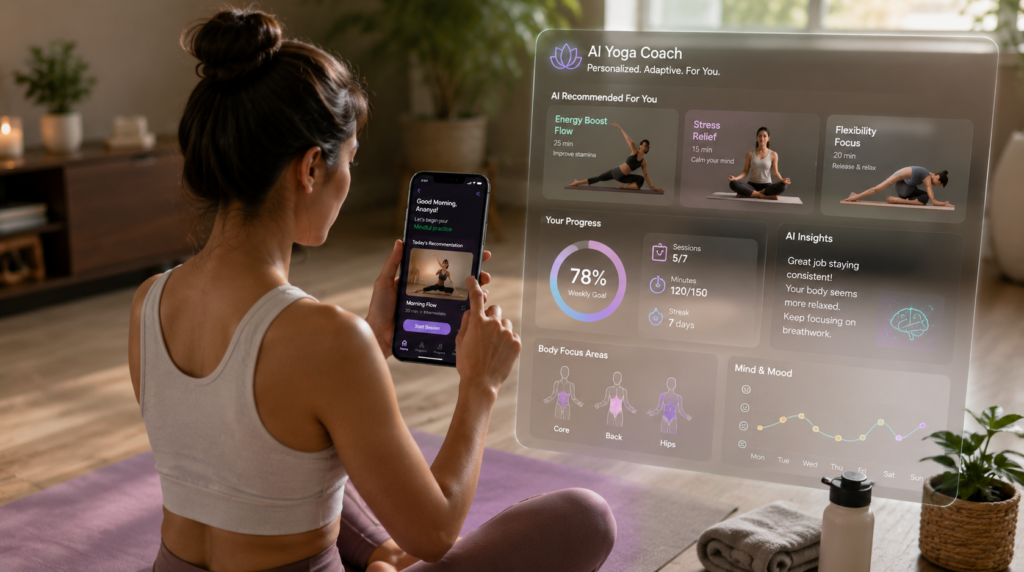
Artificial intelligence is becoming an important part of the wellness industry, and yoga is no exception.
AI-powered platforms can help create personalised yoga routines based on individual needs. Instead of following the same sequence every day, users may receive suggestions that change according to their goals and progress.
AI can also help users understand their practice. With the help of cameras and motion tracking, some digital platforms can analyse body positioning and provide feedback on alignment.
For beginners, this can make learning basic postures more approachable. A virtual system might remind a practitioner to adjust their posture, maintain balance, or move more slowly.
However, technology should be viewed as a support system rather than a complete replacement for an experienced yoga teacher. Yoga involves more than physical alignment. Breath, awareness, mindfulness, and individual experience are equally important.
The best use of AI in yoga is therefore not to replace human wisdom but to make personalised guidance more accessible.
3. Wearable Technology and Data-Driven Wellness
Wearable technology has changed how people understand their health and fitness.
Smartwatches and fitness trackers can monitor heart rate, sleep patterns, activity levels, stress indicators, and recovery. In 2026, this information can be combined with yoga and mindfulness practices to create a more complete picture of personal wellbeing.
For example, someone who notices poor sleep or high stress levels through their wearable device may choose a gentle evening yoga routine instead of an intense workout.
This encourages people to listen to their bodies rather than simply following a fixed exercise schedule.
Modern yoga is therefore becoming more connected to the idea of responsive wellness—adjusting one’s practice according to what the body and mind actually need on a particular day.
4. Virtual Reality Is Creating Immersive Yoga Spaces
Virtual reality is another emerging technology that is influencing the yoga experience.
Imagine practising yoga on a peaceful beach, in a forest surrounded by nature, or in a quiet mountain landscape without leaving your home.
Virtual reality can create immersive environments designed to encourage relaxation and focus. For people living in busy cities or working long hours indoors, these experiences can make a yoga session feel more calming and engaging.
While VR cannot recreate the complete experience of being physically present with a teacher or practising in nature, it can provide an interesting alternative for people who struggle to find peaceful spaces in their daily lives.
The modern yoga experience is increasingly becoming a combination of physical practice and digital immersion.
5. Yoga Is Becoming More Inclusive
One of the most positive developments in modern yoga is the movement toward greater inclusivity.
Historically, yoga has sometimes been presented as something accessible mainly to young, flexible, and physically fit people. Social media has often reinforced this image by focusing on advanced poses and highly flexible bodies.
In 2026, the conversation around yoga is changing.
Modern yoga communities increasingly recognise that yoga is for people of different ages, body types, abilities, and fitness levels. Adaptive yoga, chair yoga, senior-friendly practices, and beginner-focused programs are becoming more visible.
The focus is shifting away from achieving the “perfect pose” and toward developing strength, mobility, breathing awareness, and mental wellbeing.
This is an important reminder that yoga is not a competition.
The goal is not necessarily to bend further than someone else. The goal is to become more aware of your own body and mind.
6. Yoga Is Moving Beyond the Yoga Studio
Yoga has become part of many different environments.
Companies are introducing workplace yoga and mindfulness sessions to support employee wellbeing. Schools are exploring age-appropriate breathing and mindfulness practices. Hotels and resorts are offering yoga retreats and wellness experiences. Healthcare and wellness communities are increasingly interested in yoga as part of holistic lifestyle programs.
This expansion reflects a broader change in how society understands health.
People are becoming more aware that wellbeing is not only about physical fitness. Mental health, stress management, sleep, emotional balance, and social connection also matter.
Yoga fits naturally into this wider wellness approach because it combines movement, breathing, and mindfulness.
7. Shorter Yoga Sessions for Busy Lifestyles
Modern life is busy.
Many people want to practice yoga but struggle to dedicate an hour or more every day. As a result, shorter yoga sessions are becoming increasingly popular.
Five-minute breathing exercises, ten-minute morning routines, fifteen-minute desk yoga, and quick evening stretches are making yoga easier to fit into everyday life.
This reflects an important modernisation of the practice: consistency is becoming more important than duration.
A person who practices for ten minutes every day may develop a stronger habit than someone who attends a long class only once a month.
Modern yoga encourages people to find small moments of awareness throughout the day.
8. Yoga and Mental Wellbeing
In 2026, the connection between yoga and mental wellbeing is receiving greater attention.
Modern lifestyles are often associated with digital overload, constant notifications, work pressure, and information fatigue. People are searching for ways to slow down and reconnect with themselves.
Yoga provides an opportunity to pause.
Breathing exercises can encourage people to become more aware of their breath. Meditation can create moments of stillness. Physical movement can help people reconnect with their bodies after spending hours sitting at a desk.
The modern yoga movement is therefore becoming less focused on flexibility and more focused on overall wellbeing.
The question is no longer simply, “How flexible are you?”
It is increasingly becoming, “How do you feel after your practice?”
9. The Rise of Hybrid Yoga
Another major trend in 2026 is the growth of hybrid yoga experiences.
A practitioner might attend an in-person class once a week while using an app for daily practice. They might join a live online session from home and occasionally attend a retreat.
This hybrid approach offers the best of both worlds.
In-person classes provide community, personal interaction, and guidance from teachers. Digital platforms offer convenience and flexibility.
The future of yoga may therefore not be entirely digital or entirely traditional. Instead, it may combine both approaches according to individual preferences.
10. Yoga Is Becoming a Lifestyle, Not Just an Exercise
Perhaps the biggest modernisation of yoga is the shift in how people understand its purpose.
For many modern practitioners, yoga is no longer simply a workout. It is becoming part of a broader lifestyle focused on conscious living.
This may include mindful eating, better sleep, meditation, digital detox, sustainable living, emotional awareness, and personal growth.
The modern yoga practitioner may finish a physical yoga session and continue the principles of mindfulness throughout the day.
In this sense, the modernisation of yoga is not necessarily about changing its core philosophy. It is about finding new ways to apply timeless principles to modern challenges.
11. Social Media Is Changing How Yoga Is Shared
Social media has played a major role in making yoga globally accessible.
Short videos, online communities, live classes, and educational content allow people to discover different styles and approaches to yoga. Beginners can learn basic concepts, follow teachers, and find inspiration from practitioners around the world.
At the same time, social media has also created challenges.
The pressure to perform advanced poses or create visually perfect yoga content can sometimes make people feel that they are not “good enough” at yoga.
The modern yoga community is gradually responding by promoting more realistic and inclusive representations of practice.
The message is becoming clearer: yoga is about the journey, not the Instagram post.
12. The Future: Ancient Wisdom Meets Modern Innovation
The modernisation of yoga in 2026 represents an interesting balance between tradition and innovation.
Technology is changing how people learn and practise yoga. AI is creating personalised experiences. Wearables are helping people understand their bodies. Virtual reality is creating immersive environments. Online communities are connecting practitioners globally.
Yet the fundamental purpose of yoga remains remarkably relevant.
The world may change. Technology may evolve. Lifestyles may become faster. But the human need for balance, peace, awareness, and connection remains the same.
The future of yoga will likely be about creating harmony between ancient wisdom and modern life.
Conclusion
Yoga in 2026 is a reflection of the world we live in.
It is more digital, personalised, inclusive, flexible, and accessible than ever before. People can practise yoga from their homes, offices, hotel rooms, or outdoor spaces. They can use technology to track their progress, access personalised routines, and connect with teachers and communities across the world.
But modernisation does not have to mean losing tradition.
At its heart, yoga continues to encourage awareness of the body, breath, mind, and present moment. Technology may change the way we practise, but the deeper purpose of yoga remains timeless.
Perhaps the true future of yoga is not about choosing between ancient tradition and modern technology.
It is about bringing the two together.
In a world that is becoming increasingly fast, connected, and digitally driven, yoga offers something deeply valuable: the opportunity to slow down, breathe, reconnect, and simply be present.
And that may be the most modern thing about yoga of all.