
Is AI Threat to Digital Marketers? What Changes in 2026
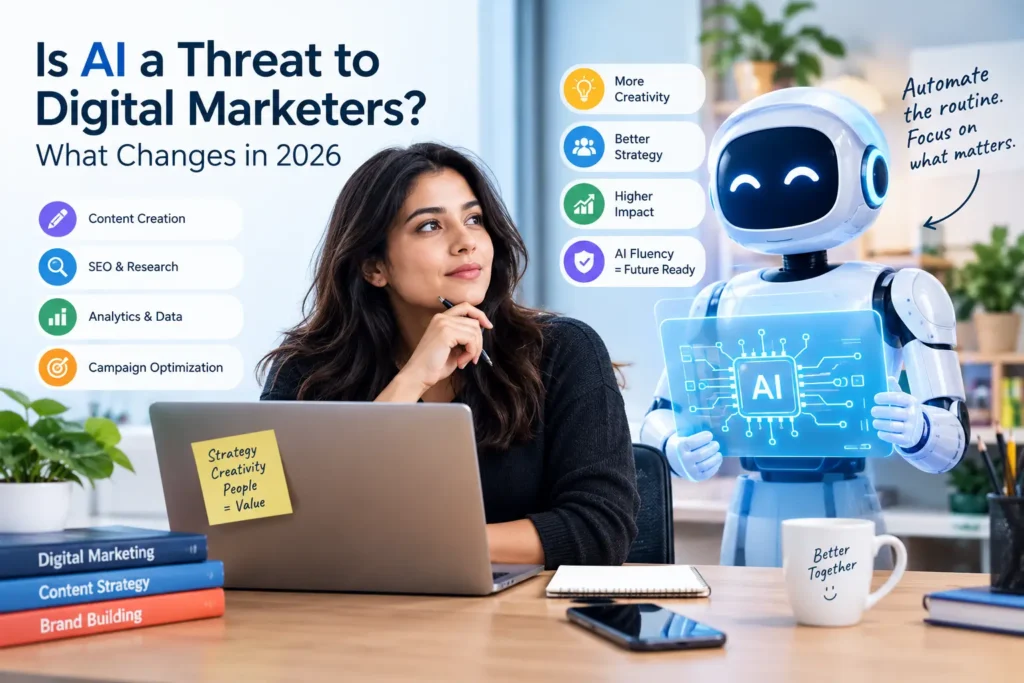
AI threat to digital marketers is no longer a question of whether artificial intelligence will affect the industry—it is a question of how quickly marketing roles will change. AI is already influencing SEO, content creation, analytics, research, advertising and customer insights. For digital marketers, the biggest shift is not necessarily the disappearance of marketing jobs, but the growing importance of knowing how to use AI while still providing human strategy, creativity and judgment.
AI is also changing the way brands approach emerging fashion and consumer trends, including linen clothing trends in 2026.
AI Threat to Digital Marketers: What Is Actually Changing?
Digital marketing contains many repetitive tasks. Marketers may research keywords, create content outlines, write variations of advertisements, summarize campaign data, generate reports, organize customer information and produce social media drafts.
AI can accelerate many of these activities.
That does not automatically mean the marketer becomes unnecessary. Instead, the marketer’s role can move toward deciding what should be done, checking whether the output is correct and connecting individual activities to a larger strategy.
AI Is Strong at Repetitive Marketing Tasks
AI tools can be useful when a task has clear inputs and repeatable patterns.
For example, a marketer might use AI to create several headline variations. The marketer can then select the most relevant options, check brand tone and test them with the intended audience.
The same principle can apply to research summaries, content briefs, first drafts and data organization.
The important point is that speed does not equal strategic judgment.
Which Digital Marketing Tasks Face the Most AI Pressure?
Some marketing activities are easier to automate than others.
The AMA’s 2026 research places several execution-focused areas, including aspects of SEO, email marketing, paid media, copywriting, lead generation and market research, toward the more disrupted end of its AI framework. It places marketing strategy, brand management, creativity, critical thinking and leadership toward the more human-led end.
This creates a useful distinction for digital marketers.
Content Production
For content teams, the AI threat to digital marketers is less about replacing every writer and more about changing how content is researched, produced and reviewed. Producing a basic article, caption or advertisement variation can increasingly be assisted by AI.
However, creating genuinely useful content still requires topic selection, evidence, original insight, editorial judgment and audience understanding.
A marketer who only sells writing speed may face more pressure than one who can turn research into a strong content strategy.
SEO
The AI threat to digital marketers is particularly visible in SEO, where search platforms and AI-generated answers are changing how people discover information.
Keyword research, content briefs, competitor analysis and initial optimization can be accelerated. However, search visibility still depends on the quality, relevance, technical accessibility and usefulness of the final page.
That means SEO professionals need to understand more than keywords.
They need to understand search intent, information architecture, internal linking, technical foundations, content quality and measurement.
Paid Advertising
AI can help generate ad variations and support targeting or analysis. Yet campaign objectives, positioning, budget decisions and interpretation still require human oversight.
A marketer must know whether an increase in clicks actually supports the business goal.
What AI Cannot Easily Replace
The most important skills are not necessarily the tasks that produce the most visible output.
Strategic Thinking
A tool can generate options. A marketer still has to determine which option fits the company’s goals.
For example, an AI system might suggest ten campaign concepts. It does not automatically know which concept fits the brand’s positioning, customer expectations, competitive environment and available resources.
Brand Judgment
Brands depend on consistency and context.
An AI-generated message may sound polished while still being inappropriate for a particular audience. Human marketers remain responsible for deciding what the brand should say and what it should avoid.
Critical Thinking
AI output can contain errors, unsupported claims or poor assumptions.
Digital marketers therefore need the ability to question the output rather than accepting it because it sounds convincing.
Creativity and Originality
AI can generate combinations of existing ideas. Marketers still need to identify meaningful opportunities and develop ideas that connect with a specific audience.
Originality also matters for content quality. Publishing large volumes of generic AI text does not automatically create useful search content.
The New Digital Marketer: AI-Assisted, Not AI-Replaced
The strongest response to AI may not be avoiding it.
Instead, digital marketers can learn how to use AI while developing skills that remain difficult to automate.
A modern workflow might look like this:
- Define the customer problem.
- Research the market and audience.
- Use AI to accelerate repetitive tasks.
- Review and verify the output.
- Add original insight and strategic context.
- Publish or launch the campaign.
- Measure business results.
- Improve the strategy based on evidence.
AI becomes part of the workflow rather than the entire workflow.
AI Threat to Digital Marketers: Skills That Matter More
AI literacy is increasingly useful, but it should not stand alone. Understanding the AI threat to digital marketers also means recognizing which skills become more valuable when routine marketing tasks are automated.
Marketers can strengthen their careers by developing a combination of:
- AI tool literacy
- SEO and search strategy
- analytics and data interpretation
- customer research
- copywriting and communication
- brand strategy
- experimentation
- critical thinking
- creative problem-solving
- marketing operations
- ethical decision-making
The AMA’s 2026 research similarly highlights AI fluency alongside adaptability, critical thinking, creativity, emotional intelligence and leadership.
Will AI Replace Digital Marketers?
It is more accurate to say that AI is likely to change digital marketing jobs than to claim that it will simply eliminate digital marketers.
The impact will vary by role, company and task.
A marketer whose work consists mostly of repetitive production may experience greater automation pressure. A marketer who combines AI fluency with strategy, customer understanding, experimentation and decision-making can use the technology differently.
Recent research into marketing vacancies also points toward employers looking for people who can combine AI with research, campaign execution, measurement and accountable human control.
How Digital Marketers Can Adapt to AI
The most practical response is to audit your current workflow.
List the tasks you perform every week. Separate them into three categories:
Automate: repetitive tasks with predictable outputs.
Assist: tasks where AI can accelerate research or drafting but still require human review.
Own: decisions that depend on strategy, relationships, judgment, ethics or accountability.
This framework helps marketers avoid two extremes: ignoring AI completely or handing important decisions to AI without sufficient review.
Final Thoughts: Is AI Threat to Digital Marketers?
Ultimately, the AI threat to digital marketers depends on how marketing professionals respond to these changes and develop their skills.
The more useful question is different:
Which marketing skills become more valuable when routine production becomes faster?
The answer increasingly includes strategy, critical thinking, creativity, customer understanding, communication and the ability to use AI responsibly.
Digital marketers do not need to compete with AI at every task. They need to understand where AI creates leverage and where human judgment remains essential.